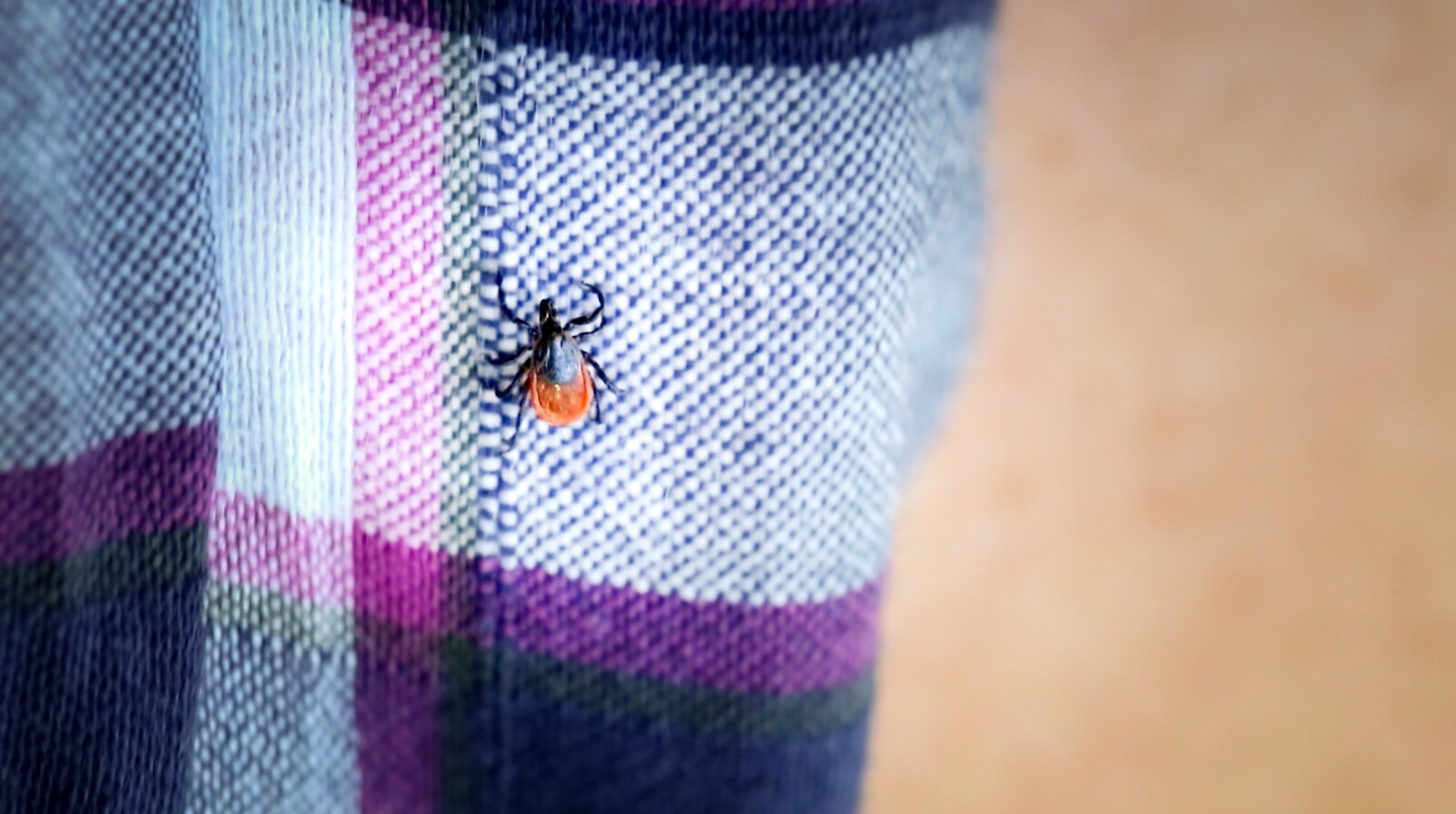
A blacklegged tick, also known as a deer tick.

Das

Hafenstein


MINNEAPOLIS — There is no vaccine or treatment for the Powassan virus, but researchers at the University of Minnesota said they have identified a weak point within the tick-borne flavivirus that could offer a route for future therapies.
Their findings come as cases of the disease, which can cause severe neurological symptoms, increase throughout Minnesota and Wisconsin, including a death in Bayfield County, Wisconsin, in June.
A study published in the journal Science Advances in July by researchers at the U of M and Pennsylvania State University outlined how the team found a pocket virus they hope could be targeted by others developing a drug to treat or a vaccine to prevent Powassan.
Using cryogenic-sample electron microscopy, a high-powered process that produces a detailed model of the virus, researchers knew where each protein chain and amino acid — the building blocks of proteins — was and how they interact.
With that, lead author Sayan Das, a doctoral candidate at the U of M Twin Cities, found an amino acid residue that interacted with a lipid pocket on the virus as it’s being assembled, and by modifying that residue, researchers were able to interrupt that assembly, causing the virus to fall apart.
“We found that upon mutating this residue, the virus is collapsing on itself,” Das said. “It’s like a pressure point where you put pressure on and the virus disassembles eventually.”
And that could be targeted by drugs, potentially leading to the first vaccine or treatment of Powassan.
“That’s how we discovered that this pocket is key to virus survival,” said Susan Hafenstein, director of cryo-EM at the University of Minnesota’s Hormel Institute and a co-author of the study. “So if we can design a drug that fills this pocket, or take away the lipids that normally fill this pocket, we can kill the virus.”
To create a safer virus that they could study in the lab, researchers swapped out some of the virus with a yellow fever virus vaccine strain.
“We had to dumb down the virus,” Hafenstein said. “We had to make it less dangerous. So to do that, we preserve the outer coating that you see with these models, so everything looks like Powassan and how it would interact with the host, how it’s transmitted, all of that’s preserved. But then we stripped out the guts of the thing, so all the genetic material inside is not dangerous.”
Like Powassan, yellow fever is a flavivirus, as are dengue, Zika and West Nile. It’s a type of virus that’s notoriously difficult to create vaccines and treatments for. But the detailed modeling of the viruses through cryogenic-sample electron microscopy could help change that.
In 2020, Hafenstein and several of the same researchers involved in this study were the first to find similar lipid pockets on the Zika virus.
All of the findings — and software developed in Hafenstein’s lab to identify the lipid pockets — are freely available to other researchers who may then be able to develop a drug.
“We’ve identified the targets, we’ve identified specific weak points, but then other labs pretty much take it from there,” Hafenstein said.
In the month since the paper was published, Hafenstein said she’s received some outside interest in the findings.
That could be tricky given federal cuts in vaccine development funding, something Hafenstein said she’s “terrified” by.
The virus, after all, can cause severe infections, and it’s spreading.
A bite from the blacklegged tick, commonly referred to as a deer tick, can infect a person in 15 minutes. Symptoms can include fever, headache, vomiting and generalized weakness. Ticks become infected with Powassan when they bite and consume the blood of an infected skunk, groundhog, squirrel, mouse or other rodent.
However, the exact source of the virus remains unknown, the News Tribune has previously reported. Ticks can also be born with Powassan.
In humans, the disease can also progress to encephalitis — with symptoms like altered mental states, seizures, speech and movement problems, and paralysis — or meningitis — with symptoms like severe headaches, sensitivity to light and neck rigidity.
Approximately 1 out of 10 people with a severe case die, and half of those with a severe case are left with long-term health problems like memory loss and recurring headaches, according to the Centers for Disease Control and Prevention.
U.S. epicenters of Powassan include the Upper Midwest and Northeast regions.
Cases of Powassan are on the rise in Minnesota and Wisconsin. Minnesota reported 14 cases in 2024 and Wisconsin reported 12 cases.
As of Aug. 5, the CDC reports Wisconsin has already reported 11 cases so far in 2025 and Minnesota has seen one.
The rise in tick-borne diseases can be attributed to several factors. Climate change has increased ticks’ habitat range and the amount of time a tick can be active. More people are living near wooded areas, and deer — the blacklegged tick’s preferred host — populations are also up.
“Given how dangerous this virus is … it is definitely important for us to focus on developing biologics or antivirals or vaccines to prevent any infection,” Das said. “And our study, it does give a well-rounded idea to move forward to develop such biologics and vaccines and antivirals against falviviruses, focusing on Powassan.”
But vaccine development — federal funding or not — doesn’t happen overnight.
In the meantime, Hafenstein said people should take precautions to avoid deer tick bites in the first place by wearing boots and treating clothes with permethrin, a tick repellent.